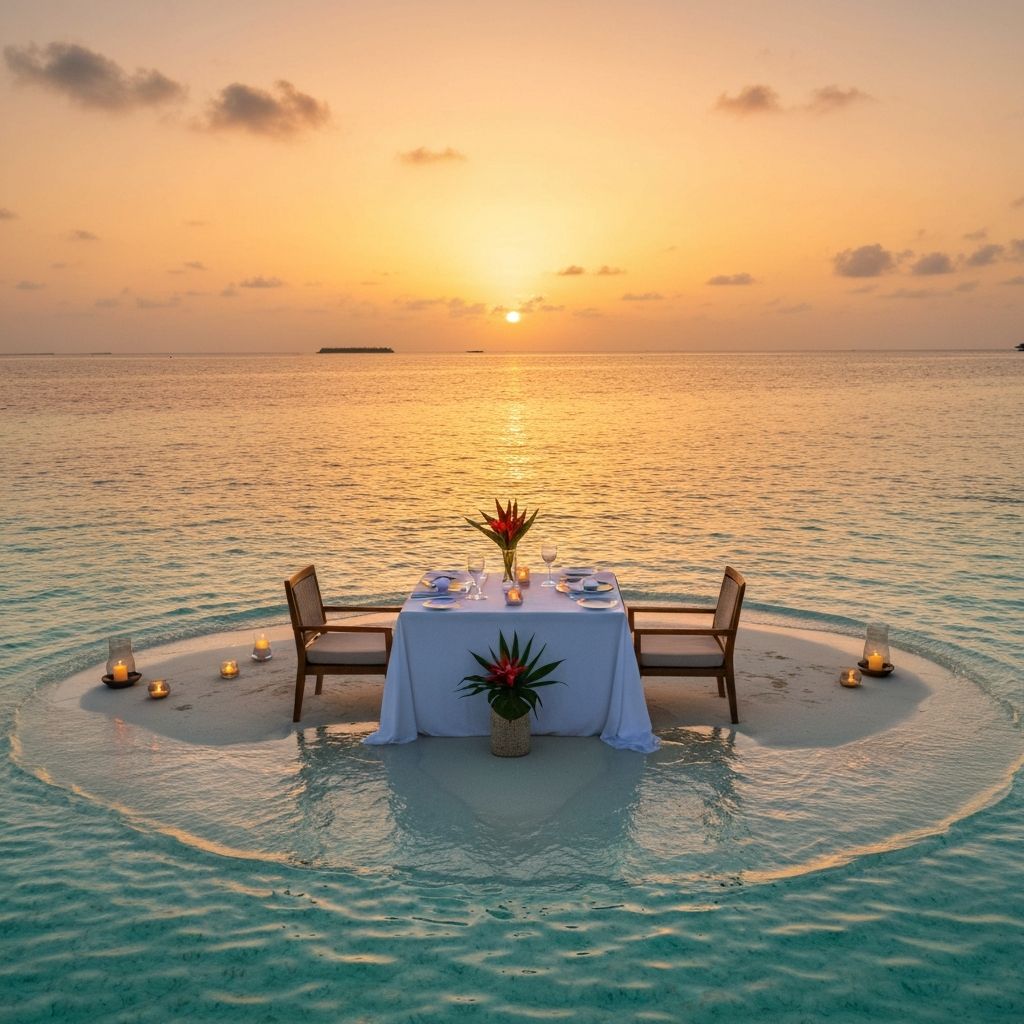
There is a moment, just as the sun surrenders to the sea, when the world holds its breath. The sky becomes a cathedral of amber and rose, the water stills into liquid copper, and the boundary between the earth and the infinite dissolves. To dine in that moment — on a hidden sandbank, on a cliffside, on a rock rising from the Indian Ocean — is to participate in something ancient and sacred.
This is the philosophy that animates the world's most extraordinary sunset dining experiences. They are not merely meals; they are ceremonies. They are invitations to slow down, to feel the salt on your lips and the warmth still radiating from the sand, to understand that the finest luxury is not what sits on the plate but the immensity that surrounds it. At Mystical Beach, we have sought out four such sanctuaries — each one a different expression of the same eternal truth: that a table with a view of the horizon is the most beautiful room in the world.
The Maldives: Private Sandbank Dinners Under the Stars
The Maldives has long been synonymous with an almost theatrical form of luxury — overwater bungalows, glass-floor ocean suites, coral reefs teeming with electric colour. But the archipelago's most profound dining experience requires none of these architectural marvels. It requires only a sandbank: a sliver of white coral sand barely wider than a dining table, rising a foot above the Indian Ocean in the middle of absolute nowhere.
The ritual begins in late afternoon. A traditional dhow — its white sail catching the warm trade wind — carries you and your companion twenty minutes from the resort. The sandbank materialises from the ocean like a rumour, fringed by water so clear you can see the shadow of your own boat on the sand fifteen feet below. A team has arrived before you: a white-clothed table, lanterns already flickering in the gathering breeze, a seafood menu built around that morning's catch of yellowfin tuna and lobster.
At the finest resorts — Soneva Jani, Cheval Blanc Randheli, Six Senses Laamu — the sandbank dinner is elevated to performance art. A sommelier arrives by canoe. A telescope waits beside the dessert course for the moment the stars emerge. There is no ambient noise but the whisper of the lagoon and the soft creak of a coconut palm. The Maldivian night sky, untouched by any light pollution for hundreds of miles, reveals itself in its full, staggering depth.
What makes this experience philosophically singular is its impermanence. At high tide, the sandbank disappears entirely. You dine on something that does not formally exist — a transient altar of sand and starlight. For one evening, the ocean grants you a table. By midnight, it reclaims it. This is slow luxury at its most honest: deeply felt, briefly held, and never forgotten.
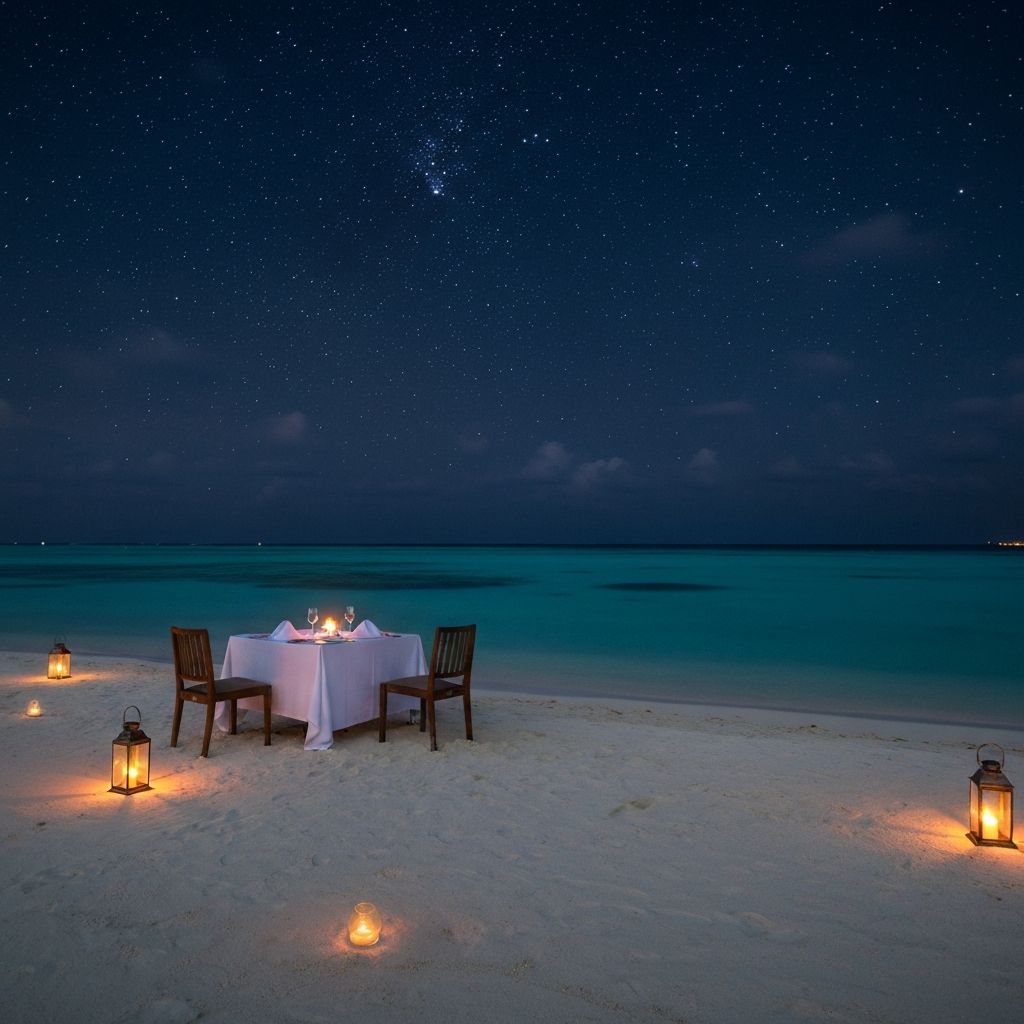
Sandbank dinners in the Maldives — a table that vanishes with the tide.
Santorini: Cliffside Gastronomy Overlooking the Caldera
If the Maldivian sandbank dinner speaks to solitude and impermanence, Santorini's cliffside dining offers something altogether different: a seat in one of the world's great natural theatres. The caldera — the drowned volcanic crater at the island's heart, ringed by 1,000-foot cliffs of black and rust-red rock — has been inspiring human wonder since the Minoan eruption reshaped the Aegean some 3,600 years ago. To eat above it, as the sun falls into the western sea, is to dine at the edge of geological time.
The great restaurants of Oia and Imerovigli — Lauda, Metaxy Mas, Selene — understand this implicitly. They are built not primarily as kitchens but as viewing platforms, establishments whose architecture is oriented entirely toward the spectacle. Stone terraces cascade down the caldera rim. Tables are positioned so that every diner faces west. Candles are lit as the shadows lengthen.
The cuisine itself is a form of storytelling. Local santorini cherry tomatoes — concentrated to an almost jammy intensity by volcanic soil and minimal rainfall — appear in every form: roasted with feta, pressed into oil, dehydrated and scattered like rubies over fresh sea bass. White Assyrtiko wine, the island's great viticultural gift, carries a mineral salinity that tastes of the caldera itself. You eat the island as you watch it.
As sunset approaches — typically between seven and eight in summer — the caldera stages its nightly transformation. The water shifts from deep Aegean blue to silver, then gold, then the most extraordinary deep rose as the sun touches the horizon. The boats below become black silhouettes. Somewhere on the opposite cliff, someone is applauding. It happens every evening, this spontaneous ovation for a natural phenomenon. Santorini is the only place on earth where the sunset receives a standing ovation.
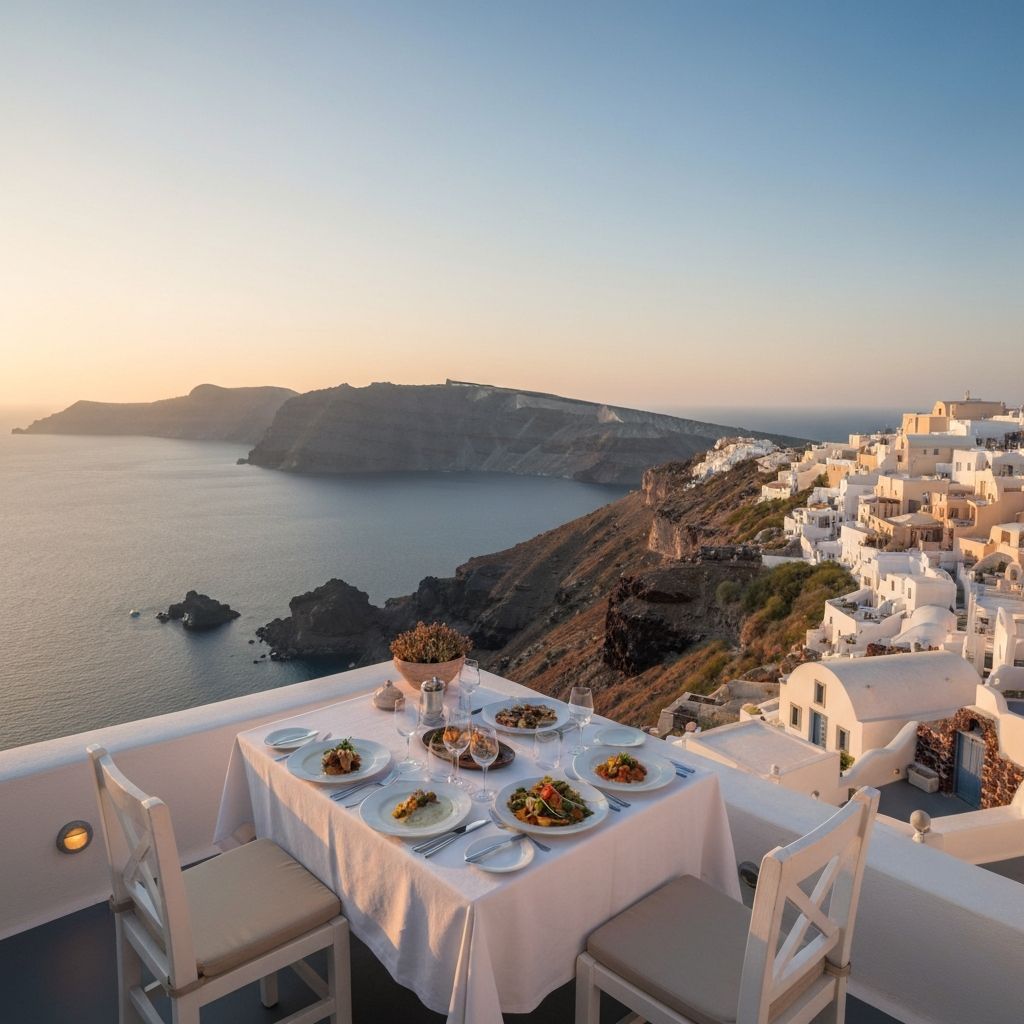
Santorini's cliffside restaurants — where every table faces west.
Zanzibar: The Rock Restaurant — Dining Amidst the Indian Ocean
Sixty metres off the shore of Michanwi Pingwe beach on Zanzibar's east coast, a small coral rock rises from the Indian Ocean. Once a fisherman's outpost, it was transformed in 2009 into The Rock Restaurant — arguably the most photographed dining establishment in Africa, and certainly one of the most theatrically situated on earth.
Access determines the experience. At low tide, you can wade to the restaurant through ankle-deep water, shoes in hand, the warm Indian Ocean lapping at your feet. At high tide, a small wooden boat ferries guests across the short stretch of sea. Both arrivals have their particular poetry — the waded approach through turquoise shallows, the boat journey with its view of the rock emerging from the water like a natural fortress.
Inside, the space is intimate: twelve tables on two levels, wooden shutters opening to sea breezes, the sound of the Indian Ocean constant and hypnotic. The menu is built on Zanzibari abundance — freshly caught reef fish, Swahili-spiced prawns, octopus prepared in coconut milk with lemongrass and ginger, lobster selected from a tank and grilled over charcoal. The spice trade that made Zanzibar famous for centuries is present in every dish.
Sunset here is a collective experience. As the equatorial sun descends rapidly — Zanzibar sits just six degrees south of the equator, meaning sunsets are swift and vertical, the sky transforming in minutes — all conversation pauses. The light turns the water around the rock from turquoise to bronze to deep copper. Dhows pass in silhouette. The Swahili coast, ancient and layered with history, glows in the final light.
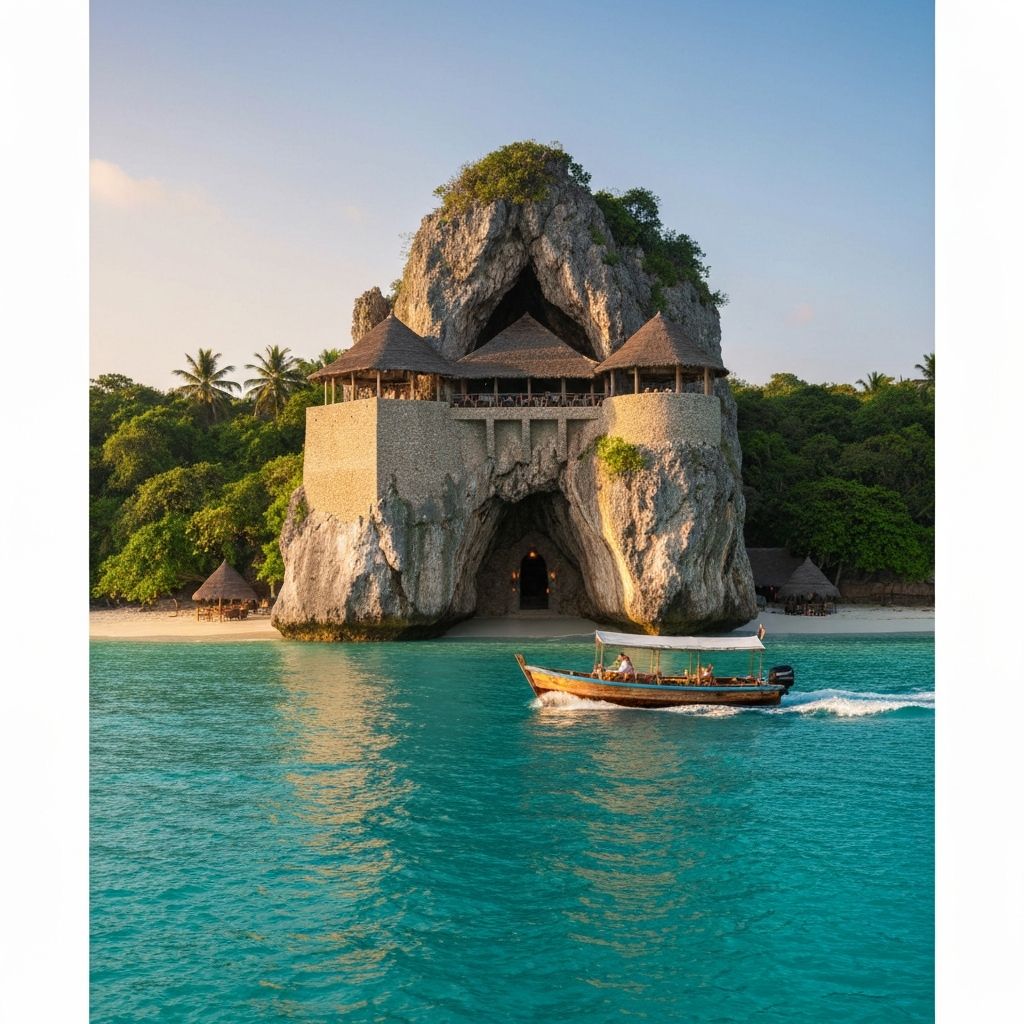
Zanzibar's Rock Restaurant — reached by wading or by boat depending on the tide.
Bora Bora: Canoe-Delivered Breakfasts and Sunset Lagoon Feasts
In Bora Bora, dining is not confined to a restaurant. The lagoon itself — an extraordinary oval of turquoise water, ringed by a coral reef and presided over by the volcanic peak of Mount Otemanu — is the setting. The water is so shallow and so clear in places that you can see the sand patterns on the bottom twenty feet below. To eat here, floating on it or surrounded by it, is to understand why French Polynesia has long been synonymous with paradise.
The most celebrated breakfast in Bora Bora is delivered by outrigger canoe. Shortly after dawn, a traditionally carved pirogue — loaded with tropical fruits, fresh pastries, local honey, and pressed coconut juice — appears at the deck of your overwater bungalow. The canoe paddler navigates the lagoon in silence. Mount Otemanu, catching the first light, reflects in the still water. You eat in bed, in paradise, with the Indian Ocean — technically the Pacific — lapping gently beneath you.
The evening's equivalent is the sunset lagoon feast, offered by resorts like the Four Seasons Bora Bora and the St. Regis. A raft is prepared in the middle of the lagoon — a floating platform hung with paper lanterns, set with a table and flowers. A motorised platform carries you out. As the sun falls behind Mount Pahia and the sky erupts in colour, a private chef presents a tasting menu inspired by Polynesian tradition: poisson cru in coconut milk, mahi-mahi with vanilla sauce, ma'a Tahiti served in banana leaves.
What Bora Bora offers — that the Maldives and Santorini cannot — is the sense of being inside the landscape rather than above or beside it. You are not watching the lagoon; you are in the lagoon. The water surrounds you. The light moves through it. The dinner is not separate from the environment; it is continuous with it. This is the most immersive form of table in the world.
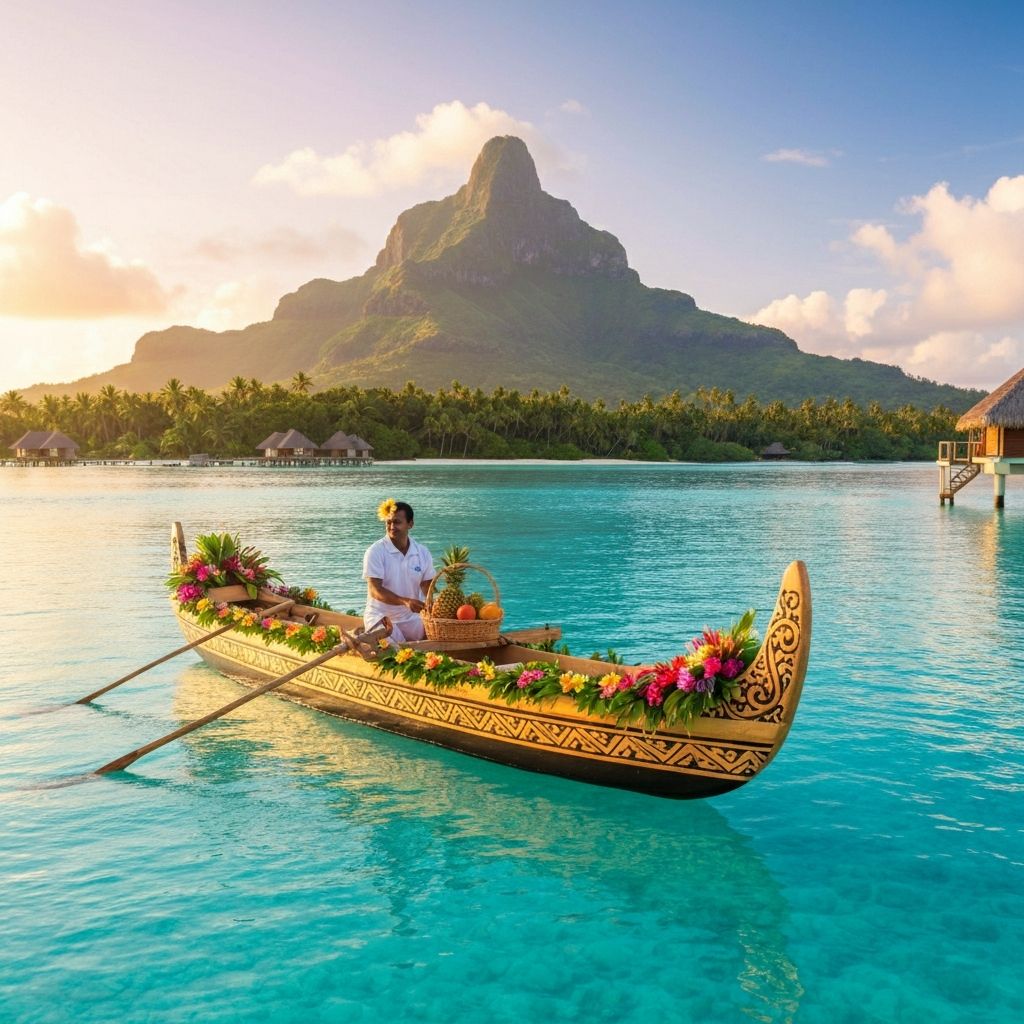
Bora Bora's canoe breakfast — the most poetic room service in the world.
The Art of the Sunset Dinner: Practical Wisdom
These experiences share a common philosophy — that the meal is a frame, not the painting. The painting is always the sky and the sea. Understanding this shapes how to approach them. A few principles for those who wish to pursue these sanctuaries with intention.
Book for One Hour Before Sunset
The best light arrives 45 minutes before the sun touches the horizon. Arriving earlier means you experience the full progression from afternoon gold to the deep rose of the final moments.
Communicate Your Occasion
These restaurants cater specifically to celebrations. A brief note at booking — 'honeymoon', 'anniversary', 'proposal' — transforms the experience. The Rock, Lauda, and Soneva all have dedicated romantics teams.
Dress for Atmosphere
The setting is formal in its beauty even when dress codes are relaxed. Flowing white linen in the Maldives, silk in Santorini, vivid colour in Zanzibar — dress as though the horizon deserves to see you.
Order the Local Ingredient
Santorini's Assyrtiko, Zanzibar's spice-route seafood, Bora Bora's poisson cru, Maldivian yellowfin — the finest thing on any menu is always the ingredient that could only have come from precisely here.
A Table at the Edge of Everything
There is something in human nature that reaches, always, toward the horizon. We walk to the edge of the land and look out. We climb to the highest point and survey. We are drawn, irresistibly, to the place where something ends and something else begins. Sunset dining, at its finest, is the ritualisation of this impulse.
The sandbank in the Maldives teaches impermanence — the beauty of what cannot be held. The caldera in Santorini offers scale — the humbling perspective of deep geological time. The rock in Zanzibar provides adventure, the sense of having earned your table. And Bora Bora's lagoon gives immersion — the feeling of being dissolved into the world rather than merely observing it.
Together, they constitute a curriculum in wonder. To have dined at all four — to have watched the sun surrender to each of these four seas — is to have accumulated something that no amount of money can purchase after the fact. It is experience, embedded in memory, inseparable from the taste of tuna and the smell of salt and the particular quality of the light in the last ten minutes before dark.
This is what Mystical Beach exists to protect and celebrate: the understanding that the finest luxury is attention — to a place, to a moment, to the person seated across from you as the sky performs its daily miracle. A table with a horizon view is not a restaurant. It is a philosophy.
Continue Your Journey
Deepen your exploration with these related sanctuaries from the Mystical Beach journal.
The Inner Sanctum
Receive Whispers from the Shore
Private discoveries, curated sanctuaries, and the quiet art of living beautifully — delivered gently to your inbox.
Rate This Article
Rate This Experience
Your feedback helps us curate exceptional content