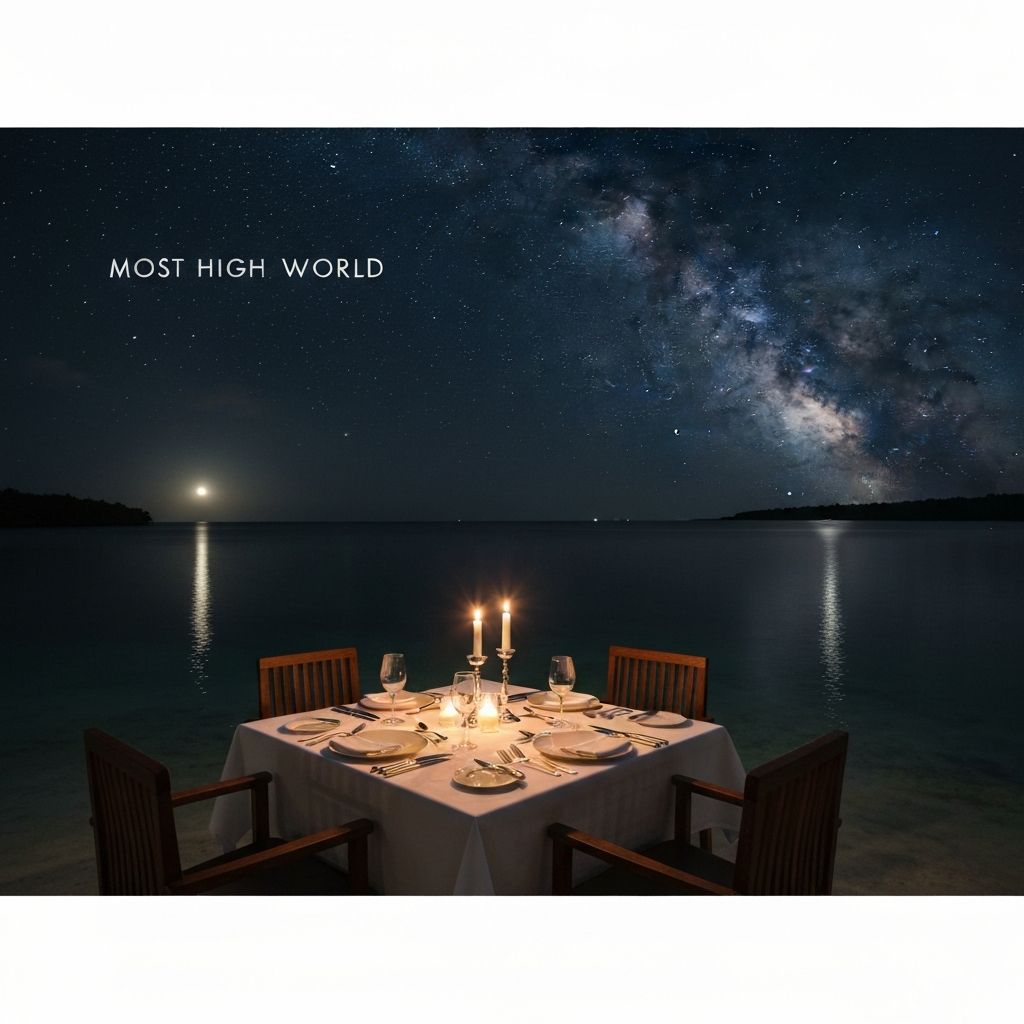
There is a sound that precedes every great meal eaten beside the ocean — a sound that no restaurant interior, however exquisite, can reproduce: the rhythm of water against sand or stone, unhurried and indifferent to the occasion, conducting its ancient conversation with the shore. It is this sound, more than the menu or the setting or even the company, that elevates ocean dining into something that engages not merely the appetite but the entire nervous system.
The finest private island dining experiences in the world understand this relationship intuitively. They are not designed to compete with the ocean — they are designed to surrender to it entirely. The table is positioned so that the horizon is always visible. The timing of the meal is calibrated against the movement of the sun. The menu reflects the ecosystem that surrounds it. The result, when everything is aligned, is a form of dining that is inseparable from a form of contemplation — a meal that nourishes not only the body but something more fundamental and less easily named.
This guide examines three private island and coastal dining experiences that have each, in their distinct manner, solved the problem of how to place a meal in conversation with the sea without diminishing either. They represent different geographies and different gastronomic philosophies, but they share a quality that distinguishes extraordinary dining from merely excellent dining: the knowledge that the most important ingredient in the meal is not in the kitchen, but in the view from the table.
Soneva Jani, Maldives: The Celestial Table
To understand the So Starstruck dinner experience at Soneva Jani is to understand what private dining can become when the ceiling of the dining room is removed and replaced with the Milky Way. The experience takes place on a private sandbank in the Noonu Atoll — a temporary island of white sand that the ocean covers and uncovers on its own schedule — accessible only by boat and illuminated by nothing beyond the stars overhead and the bioluminescence that turns the surrounding water a ghost-pale blue with every disturbance of its surface.
The celestial theme is not merely decorative. A resident astronomer guides the evening, narrating the night sky with the intimacy of someone introducing close friends — the constellations visible from the Maldives' position near the equator include southern hemisphere formations that most guests have never encountered, and the unobstructed horizon means the sky is visible in its full arc from due east to due west. A research-grade telescope is positioned on the sand. Between courses, guests are invited to look through it at whatever the astronomer has selected for the evening's programme: a planet, a cluster, a nebula whose light began its journey before the first human ancestor stood upright. The effect of eating a meal while contemplating geological time is difficult to quantify but impossible to dismiss.
The culinary programme is handled with the same philosophical care as the astronomical one. Soneva's kitchen operates according to a rigorous farm-to-table ethic: the resort maintains its own organic garden, cultivating herbs, vegetables, and edible flowers that supply the kitchen's daily needs with minimal reliance on external supply chains. For the So Starstruck experience, this produces menus where every element has a legible relationship to the Maldivian ecosystem — caught, grown, or foraged within the atoll's waters and land. The fish is identified by name and fishing method. The greens arrive still warm from the garden. The seasoning comes from the salt evaporated from the resort's own coastal pools. The meal is, in this sense, an act of ecological storytelling as much as an act of hospitality.
Soneva Jani holds the additional distinction of being one of the Maldives' most seriously committed sustainable luxury properties. The resort generates a significant proportion of its energy from solar installations, maintains a zero-waste glass studio that transforms ocean-recovered glass into decorative objects sold to guests, and contributes to a coral restoration programme that has rehabilitated large sections of the surrounding reef. The So Starstruck experience is, in this context, not merely a romantic dinner but a genuine expression of a hospitality philosophy that refuses to separate the pleasure of guests from the health of the ecosystem that makes that pleasure possible.
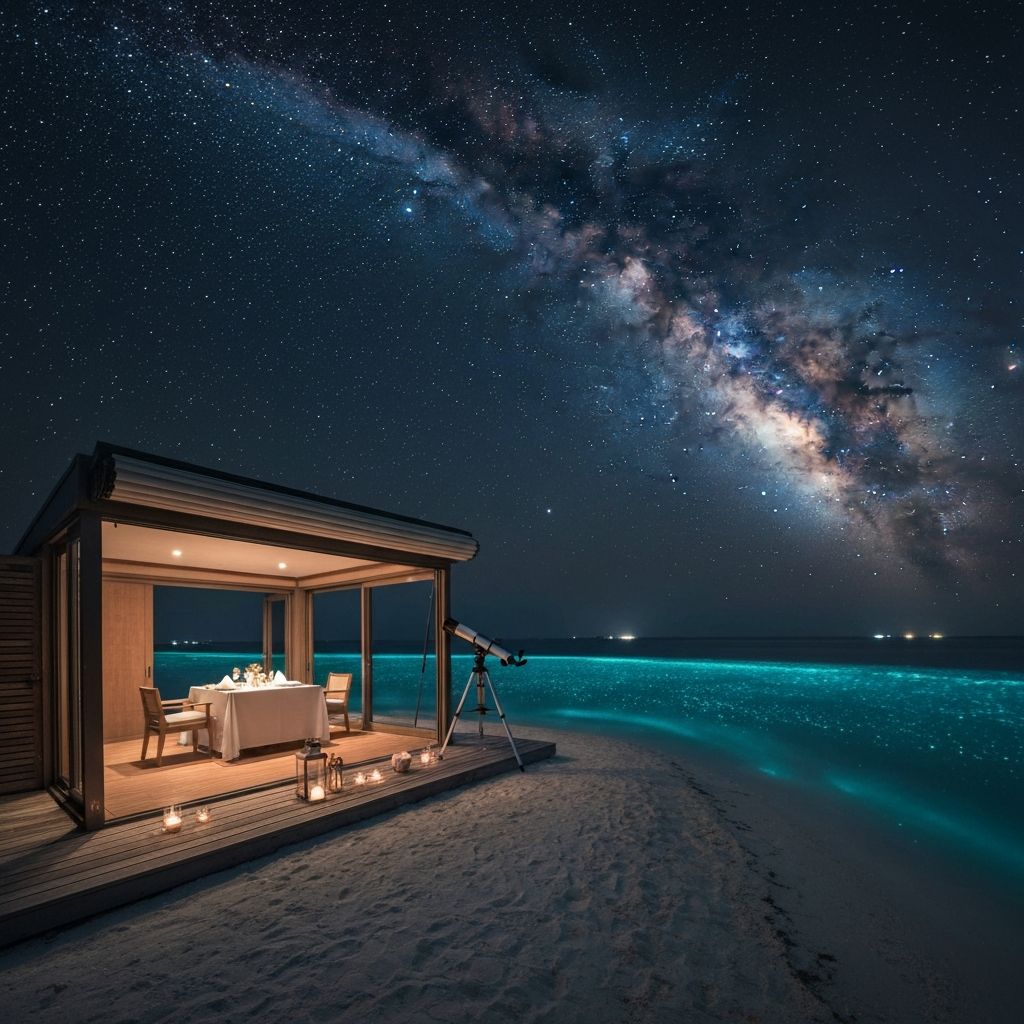
Soneva Jani, Maldives — where the dining room ceiling is the Milky Way
Belmond Hotel Splendido, Italy: The Aperitivo Ritual Above Portofino
There are meals that are remembered for the food, and meals that are remembered for the light. The cliffside aperitivo at Belmond Hotel Splendido belongs firmly to the second category — and would do so even if the Negronis were indifferent, which they are not. Portofino's harbour lies directly below the Splendido's terraces, its painted houses reflected in the turquoise water of the protected bay, the peninsula's parasol pines framing the view with the studied casualness of a Matisse composition. In the late afternoon, the light on this scene does something that photographers travel significant distances to capture and rarely quite manage: it turns every surface — the water, the stone, the faded ochre and rose of the harbour facades — into something that appears to be lit from within rather than from above.
The aperitivo hour in Italy is a serious institution, and nowhere is it taken more seriously than at the Splendido, where the ritual of the pre-dinner drink becomes, in the context of this particular view, something closer to a ceremony. The hotel's bar team produces a programme of classic and house-original cocktails using Ligurian botanical infusions — local herbs, coastal citrus, and the extraordinary Cinque Terre white wines that grow on the steep terraced hillsides to the east. The accompanying cicchetti draw on the Ligurian larder with the same intelligence: focaccia from a sourdough culture maintained for decades, anchovies from the Ligurian sea preserved in the house method, pesto prepared daily using the small-leaved basil that grows only in the microclimate of the Genoa hills.
The Splendido's kitchen approaches the question of sustainable luxury from the Italian perspective, which tends to frame sustainability not as a modern ethical project but as a centuries-old tradition of respecting local producers, seasonal availability, and the integrity of ingredients. The executive chef's sourcing relationships with Ligurian fishermen, the hotel's own kitchen garden on the hillside above the main building, and the wine programme's commitment to the region's small-production natural winemakers — these are not marketing positions but genuine expressions of a culinary philosophy rooted in the land and sea of the Ligurian coast. The aperitivo table, in this context, becomes a brief, luminous argument for the proposition that terroir and hospitality are, ultimately, the same thing.
Dinner follows at the La Terrazza restaurant, where the view that accompanied the aperitivo is now lit by the harbour's evening reflections and the scattered lights of the hillside above — a transformation that confirms what the best Italian restaurants have always understood: that the dining room is not a container for an experience but an active participant in it. The menu moves through the Ligurian canon with the fluency of a native speaker rather than a tourist's phrase-book recitation: trofie al pesto with a brightness that makes every other version seem approximate; branzino from the morning's catch, prepared with the oil and lemon restraint that reveals rather than decorates; a tiramisù that has been refined over several kitchen generations into something that functions less as a dessert than as a closing argument.
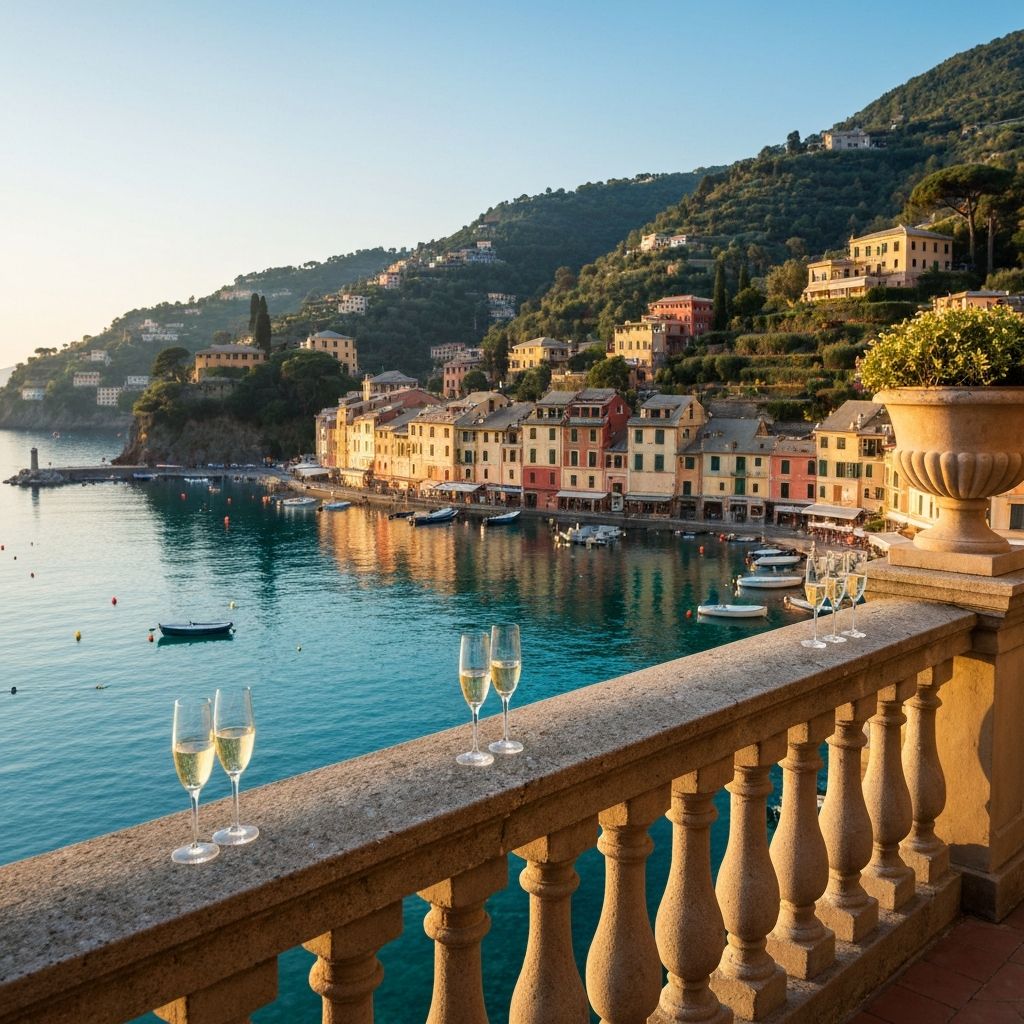
Belmond Hotel Splendido, Portofino — where the aperitivo hour becomes a ceremony of light
Nihi Sumba, Indonesia: Dining Above the Indian Ocean at the Mamole Treehouse
The Mamole Treehouse at Nihi Sumba is positioned at the kind of height above the ocean that makes the act of sitting down to a meal feel like a gentle imposition of domesticity on a landscape that is not particularly interested in being domesticated. Built into the canopy above the resort's coastal jungle, its thatched platform accessible by a steep path through vegetation that closes behind the guest within fifty meters, the treehouse operates as a space entirely outside the ordinary logic of restaurant dining. There is no street below. There is no adjacent table. There is the forest around and below, the Indian Ocean ahead and below, and between the two a sky that performs its sunset programme with an intensity that seems proportional to the audience's remove from ordinary life.
Nihi Sumba's culinary philosophy is rooted in the organic farm that supplies approximately seventy percent of the kitchen's produce — a figure that is not a marketing claim but a measurable consequence of the resort's investment in agricultural infrastructure that most luxury properties decline to attempt. The farm grows the chillies, herbs, tropical fruits, and root vegetables that form the foundation of the kitchen's Indonesian-inflected menus; the protein comes from sustainable fishing arrangements with local Sumbanese fishermen who have supplied the resort since its founding and whose knowledge of the seasonal movements of fish in the surrounding waters constitutes a form of expertise that no procurement database could replicate.
The Mamole Treehouse dinner is, by design, an immersion in Sumbanese culinary culture rather than a performance of generic tropical luxury. The menu draws on the island's indigenous ingredient traditions — the use of lontar palm products, the specific varieties of sweet potato and cassava that are central to Sumbanese cuisine, the grilling and smoking techniques that characterize the island's ceremonial cooking — and presents them in a form that is neither condescending simplification nor aggressive modernization, but the kind of natural evolution that occurs when skilled cooks take local tradition seriously enough to understand it deeply before attempting to express it anew.
The sustainable luxury credentials of the Nihi Sumba experience extend well beyond the kitchen. The resort's Sumba Foundation operates health clinics, freshwater wells, and educational programmes across surrounding communities, funded in part by a mandatory daily foundation fee that every guest contributes. This means that the meal eaten in the Mamole Treehouse is, in a traceable and concrete way, contributing to the education of children in the villages visible from the platform. The connection between the pleasure of the guest and the welfare of the community is not a narrative imposed by marketing — it is a structural feature of the resort's economics. It is, perhaps, the most honest form of farm-to-table ethics available: not merely the traceability of ingredients, but the traceability of the meal's economic impact on the landscape from which those ingredients came.
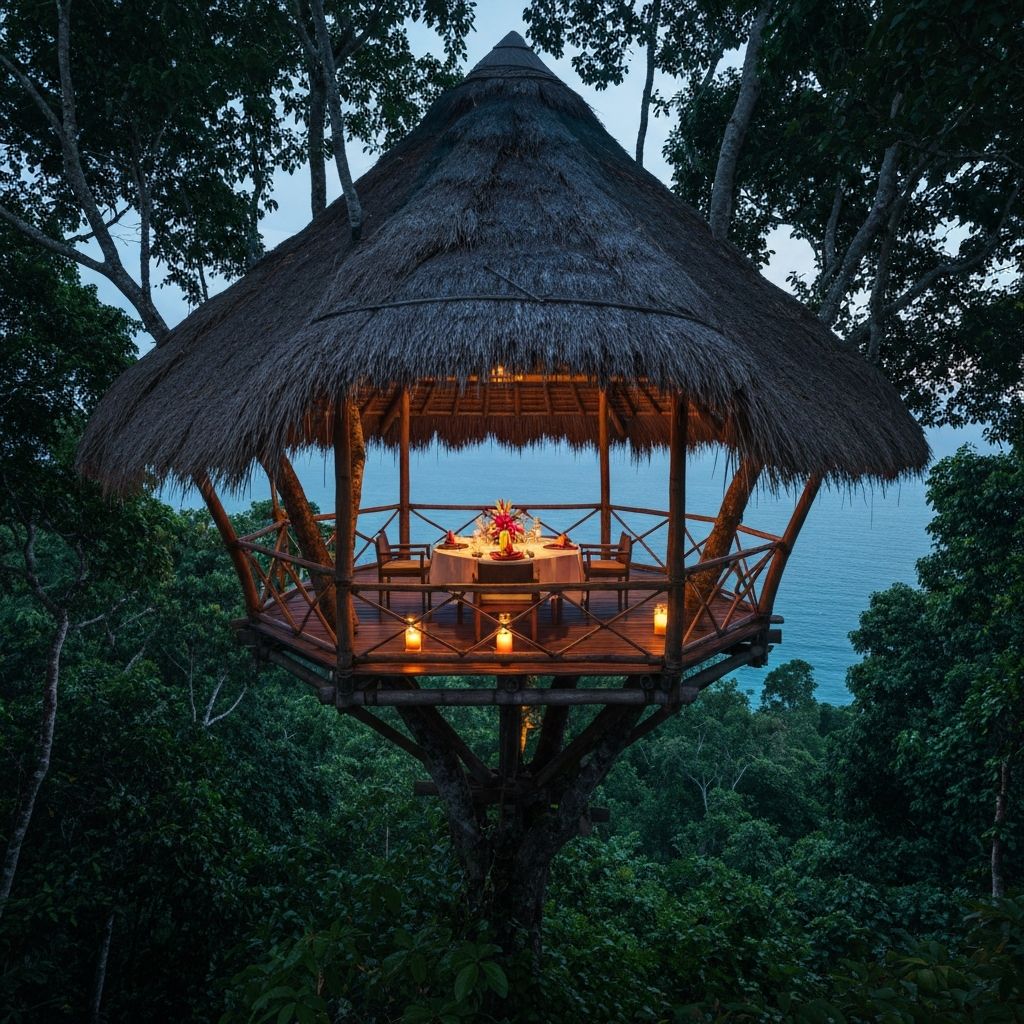
Nihi Sumba, Indonesia — the Mamole Treehouse, where the forest and the ocean share the table
Farm-to-Table Ethics as Luxury Philosophy
The three dining experiences in this guide share a commitment to farm-to-table ethics that goes deeper than the phrase has typically been used to mean. In the context of sustainable luxury hospitality, farm-to-table is not a menu formatting choice or a PR strategy — it is a complete philosophical position on the relationship between the place where food is grown, the people who grow it, the environment that sustains both, and the guest who ultimately benefits from all three. When Soneva Jani traces the provenance of every ingredient on the So Starstruck menu; when Belmond Splendido sources its anchovies from fishermen who have been working the same Ligurian waters for generations; when Nihi Sumba builds a dining programme around a farm that directly employs Sumbanese agricultural workers — these choices are not gestures toward ethical consumption. They are the foundation of the dining experience itself.
The practical consequence of this commitment, for the guest, is a form of flavor authenticity that is genuinely difficult to produce by other means. Ingredients that travel short distances between soil and plate retain qualities — the volatile aromatic compounds in freshly cut herbs, the natural sweetness of vegetables harvested at peak ripeness, the textural integrity of fish that has not been subjected to extended cold storage — that are impossible to engineer from ingredients that have traveled significant distances through complex supply chains. The finest private island dining experiences taste the way they do not because of exceptional culinary technique alone, but because the raw materials available to the kitchen are of a quality that few urban restaurants, regardless of budget, can access.
Sustainable luxury, understood in this way, is not a constraint on pleasure but an amplifier of it — a recognition that the most extraordinary sensory experiences are those most deeply rooted in the specific character of the place where they occur. The meal on the Maldivian sandbank tastes of the Maldives. The aperitivo on the Portofino cliff tastes of Liguria. The treehouse dinner above the Indian Ocean tastes of Sumba. This specificity — this absolute insistence on the genius loci as the primary ingredient — is what separates private island dining at the highest level from the generic luxury standard, and what ensures that the experiences described here cannot, by definition, be replicated anywhere else on Earth.
Planning Your Table at the Edge of the World
Reserve Far in Advance
Private island dining experiences at Soneva Jani and Nihi Sumba are limited by physical capacity — the sandbank accommodates one party per evening; the Mamole Treehouse seats a maximum of eight. Reservations for peak season (November to April in the Maldives; May to October in Indonesia) should be made at the time of resort booking, not on arrival.
Time Your Arrival
The aperitivo experience at Belmond Splendido reaches its peak at approximately 6:30pm in summer and 5:00pm in shoulder season, when the sun descends toward the peninsula at an angle that lights the harbour from the west. Ask the concierge to confirm the optimal timing for your specific dates — the difference between arriving ten minutes before and ten minutes after the peak is significant.
Communicate Dietary Requirements Early
Kitchens at private island properties operate with smaller teams and more limited supply chains than urban restaurants. Dietary requirements — particularly complex ones — are best communicated at the time of booking rather than on arrival. All three properties in this guide can accommodate most requirements with advance notice; none can reliably do so without it.
Allow the Evening to be Unplanned
The most common mistake made at private island dining experiences is arriving with a fixed idea of the correct duration. The So Starstruck experience at Soneva Jani is designed to last as long as the astronomer and the stars and the guests collectively determine. The aperitivo at Splendido has no natural closing time. These are not meals with an ending — they are meals that conclude when the evening decides they should. The guest who understands this will have the better experience.
Continue the Conversation with the Ocean
The experiences described in this guide represent three distinct expressions of a single truth: that the relationship between fine dining and the ocean is not incidental but essential — that the sea, with its particular quality of light and sound and temporal scale, is the only dining companion that reliably exceeds the food. Guests who have experienced the So Starstruck dinner or the Mamole Treehouse will often describe the meal in terms that make no reference to the food at all — what they remember is the bioluminescence, or the sound of the forest below, or the moment when the astronomer pointed the telescope at a galaxy that existed before the Earth did. This is not a failure of culinary ambition. It is its highest achievement.
For those planning a journey to these shores, our Sunset Beach Dining guide explores four more extraordinary oceanfront tables — from the Maldives' private sandbank to Bora Bora's canoe-delivered feast. And for those who wish to immerse themselves in the full context of the resorts that host these experiences, our Marriott Bonvoy Beach Wedding Resorts guide examines the broader portfolio of properties where the dining table is inseparable from the ceremonial relationship between guest and landscape.
A Letter from the Shore
Receive Whispers from the Shore
Let the tide carry our most intimate dispatches to you — private tables at the edge of the ocean, forgotten islands, and the sacred art of dining with nothing between you and the horizon.
The Ocean as the Final Course
Every meal ends. The plates are cleared, the glasses emptied, the candles allowed to burn down or extinguished. But the private island dining experiences described in this guide have a quality that distinguishes them from even the finest urban restaurant meal: the ending is not an ending. When dinner on the sandbank at Soneva Jani concludes, the ocean remains — the bioluminescence still moving in the disturbed water, the stars still performing their slow westward rotation above the atoll. When the last grappa is poured at Splendido's terrace, the harbour below is lit by reflections that are, if anything, more beautiful than those that accompanied the aperitivo. When the Mamole Treehouse falls silent after the dessert course, the Indian Ocean is still doing, in the darkness below the canopy, what it has been doing since long before anyone built a table above it.
The ocean, in these experiences, is not a backdrop. It is the meal itself — or rather, it is the context within which the meal becomes something that it could not be anywhere else. The tasting menu is a vehicle for arriving at the view. The view is a vehicle for arriving at the silence. The silence is a vehicle for arriving at whatever the guest most needed to find when they left home and chose, among all the possible tables in the world, to come here, to this edge, to eat in the company of the tide.
Rate This Experience
Your feedback helps us curate exceptional content